Blast-Resistant Walls: How Polyurea Retrofits Work
How sprayed polyurea retrofits keep masonry walls from turning into debris in a blast, based on Air Force research, plus the standards that apply.
What this guide covers
- How Blasts Damage Walls
- Two Approaches to Blast-Resistant Walls
- The Air Force Research Behind Polyurea Retrofits
- How a Polyurea Wall Retrofit Works
- What Retrofits Do Not Do
In a bombing, most injuries are not caused by the pressure wave itself. They come from the building: shattered windows, collapsing walls, and pieces of masonry thrown into occupied rooms at high speed. That insight drove two decades of research into a simple idea: if you can keep a wall in one piece, even while it bends and cracks, you can protect the people behind it. This article explains how blast-resistant walls work, how sprayed polyurea retrofits came out of U.S. Air Force research, and what standards govern blast protection for buildings.
How Blasts Damage Walls
An explosion releases a short, intense pressure pulse that strikes the face of a building. Unreinforced concrete masonry unit (CMU) walls, which are common in older facilities and many military buildings, are strong in compression but weak in bending. When the blast load pushes the middle of the wall inward, the mortar joints and blocks crack and the wall can break apart, sending fragments into the room.
The peer-reviewed paper Explosive Testing of Polymer Retrofit Masonry Walls (Journal of Performance of Constructed Facilities, 2004) makes the point directly: most casualties in such attacks are caused not by the blast itself but by the disintegration and fragmentation of walls, shattering windows, and unsecured objects propelled by the blast.
Two Approaches to Blast-Resistant Walls
There are two broad strategies for protecting occupants:
- Harden the structure. Build or upgrade walls with reinforced concrete, grouted and reinforced masonry, or steel so they resist the load without failing. This is effective but heavy, slow, and costly for existing buildings.
- Contain the failure. Accept that the wall may crack and deflect, but add a ductile layer that holds the debris together so it does not enter the occupied space.
Sprayed elastomer retrofits are an example of the second approach. They are designed for existing buildings where full structural hardening is impractical.
The Air Force Research Behind Polyurea Retrofits
Since 1995, the Air Force Research Laboratory (AFRL) at Tyndall Air Force Base in Florida has investigated ways to retrofit walls to resist external explosions. An Air Force news article on the program describes how the work evolved:
- Engineers first tried strong, stiff composite materials, but found them too stiff and brittle under dynamic loads.
- They moved to high-strength fabrics applied with epoxy, which added strength and ductility.
- Looking for a more affordable and flexible approach, they tested fabrics in a polyurethane elastomer matrix.
- Finally, they evaluated the sprayed elastomer without fabric reinforcement. Full-scale explosive tests on concrete block walls and lightweight trailers showed that the elastomer alone could provide adequate protection.
The same article reports that the branch’s engineers looked at 25 commercially available polymers to understand their mechanical properties before selecting one, and that the elastomer samples stretched to about twice their original length before rupturing. That stretch is what lets a coated wall flex while holding its pieces together. The article also notes that these elastomers are the same family of materials commonly used for pickup truck bed liners, water tank liners, and food processing areas, which made them readily available and quick to apply.
A follow-up paper, Failure Mechanisms of Polymer-Reinforced Concrete Masonry Walls Subjected to Blast (Journal of Structural Engineering, 2005), describes how thin elastomeric membranes applied to the wall interior prevented breaching and collapse of unreinforced masonry walls in explosive tests, and used finite-element modeling to study the failure mechanisms.
How a Polyurea Wall Retrofit Works
The concept is straightforward, even though the engineering behind it is not:
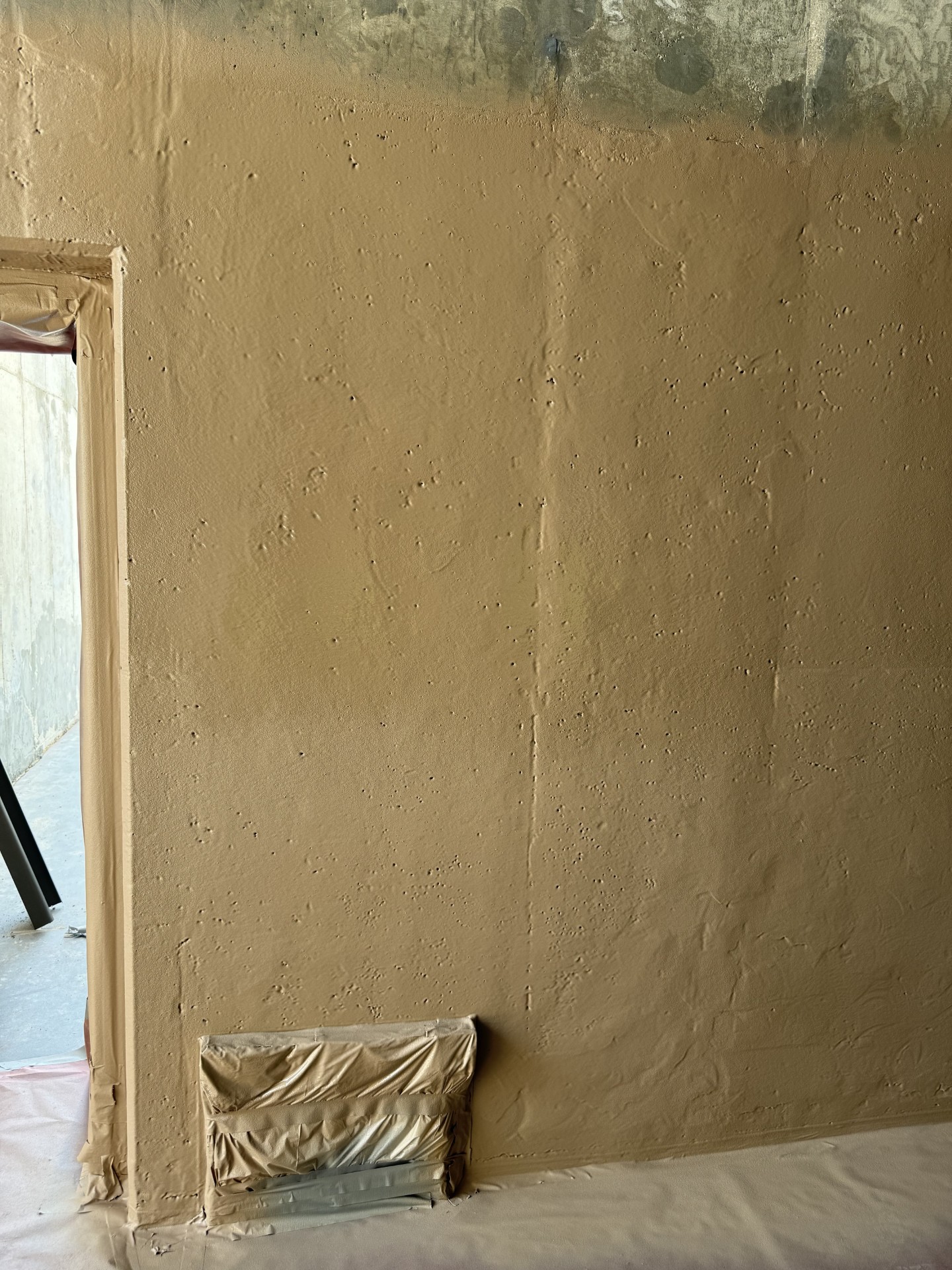
- Interior application. The elastomer is sprayed on the inside face of the wall, the side facing the occupants. When the blast pushes the wall inward, the interior face goes into tension, and the membrane acts like a net.
- Bonding to the wall. The coating bonds to the masonry, so as blocks crack, the pieces stay attached to the membrane rather than flying free.
- Anchoring at the edges. How the membrane is attached at the floor, ceiling, and sides is a key design detail. A coating that peels away at the edges can let the whole wall section move into the room.
- Ductile response. The wall may deflect significantly and the masonry may be destroyed, but the goal is that the debris stays contained so people can get out safely.
One AFRL researcher quoted in the Air Force article summarized the goal this way: “Our primary concern was that the structure hold up well enough for people to get out safely following an explosion.”
What Retrofits Do Not Do
It is easy to overstate this technology. A sprayed elastomer retrofit is a fragment containment measure. It is not:
- A bullet-resistant barrier. For ballistic threats, see our guides to UL 752 levels and bullet-resistant panels and materials, and our explainer Is Bulletproof Paint Real?
- A substitute for standoff distance, window protection, or structural design required by the applicable standard.
- A guarantee for every wall. Performance depends on the wall construction, coating material and thickness, edge attachment, and the size and distance of the threat. A retrofit should be designed by a qualified blast engineer for the specific building.
Standards That Govern Blast Protection
Blast protection for buildings is typically driven by government standards rather than product ratings:
- Department of Defense. UFC 4-010-01, DoD Minimum Antiterrorism Standards for Buildings sets minimum antiterrorism measures for DoD buildings where no specific threat or level of protection has been determined. The standard traces its origin to the findings after the 1996 Khobar Towers bombing, which noted there were no force protection standards for fixed DoD facilities. It covers standoff distances, building construction, windows, and other measures.
- Federal civilian facilities. The Interagency Security Committee’s Risk Management Process is the standard federal agencies use to determine facility security levels and countermeasures. UFC 4-010-01 itself points to the ISC standard for DoD space in leased or GSA buildings off DoD property.
For private buildings, there is usually no blast requirement unless the owner or a tenant chooses one, but owners often borrow from these documents when they decide to add protection.
Where Polyurea Retrofits Make Sense
Elastomer retrofits are most relevant where:
- The building has existing unreinforced masonry or lightweight walls that would generate debris in a blast.
- Full structural hardening is impractical because of cost, schedule, or occupancy.
- Standoff distance from potential threats is limited.
- Expeditionary or temporary structures, such as trailers and modular buildings, need fast protection.
The fast cure and spray application of polyurea mean that work can often be completed with less disruption than structural upgrades. For a look at related uses on vehicles, see our article on spray-on armor for military vehicles, and for interior fragment control in vehicles, our guide to spall liners.
Questions to Ask Before a Blast Retrofit
- What threat (charge size and standoff) is the design based on, and who performed the assessment?
- Which standard governs the building, if any: UFC 4-010-01, the ISC process, or an owner requirement?
- What coating material and thickness are specified, and what test data supports that specification?
- How will the membrane be anchored at the floor, ceiling, and wall edges?
- How are windows, doors, and other openings being addressed? A protected wall with unprotected glazing leaves a major hazard in place.
- What surface preparation and quality control will the applicator follow to ensure the bond to the wall?
Key Takeaways
- Most blast injuries come from building debris, not the pressure wave alone.
- AFRL research at Tyndall Air Force Base showed that a sprayed elastomer on the interior of masonry walls can contain fragments during explosive tests.
- The approach accepts that the wall may crack and deflect, and focuses on keeping debris out of occupied space.
- Retrofits do not replace standoff, window protection, or engineering, and they are not bullet resistant.
- UFC 4-010-01 and the ISC Risk Management Process are the main government standards for building blast protection.